
Language & Currency

Determining whether a gemstone is a genuine earth-mined treasure, a lab-created synthetic duplicate, or an inexpensive glass imitation requires a trained eye, systematic physical checks, and a deep understanding of gemology. With the market increasingly saturated with sophisticated synthetics and lookalike materials, verifying authenticity is a crucial skill for jewelry collectors, crafters, and buyers.
This expanded, SEO-optimized guide outlines professional-grade techniques, home testing strategies, and critical evaluation standards to help you master gemstone verification.
In this guide
1. Macro Visual Analysis: Color, Saturation, and Symmetry
Before bringing any magnification tools to a stone, evaluate its macroscopic visual traits under balanced daylight or a full-spectrum desk lamp.
- The Flawlessness Trap: Many buyers assume a high-value stone should look pristine. In reality, earth-mined stones grow under chaotic geological conditions over millions of years, meaning they almost always harbor internal fingerprints, needles, or crystal inclusions. If a high-end gemstone like an emerald or ruby looks completely flawless to the naked eye, it is often a major red flag for a synthetic origin.
- Evaluating Color Distribution: Natural stones typically feature subtle color variations, zoning, or natural shifts in hue. Overly bright, neon, or completely uniform coloration throughout the entire volume can indicate artificial dyeing, glass filling, or lab growth.
- Surface Polish and Luster: Genuine minerals possess high refractive performance and surface durability. If a stone marketed as a hard gemstone displays pitting, surface orange-peel textures, or rounded facet edges, it is usually a softer molded glass or plastic imitation.
2. Microscopic Inspection Using a Jeweler’s Loupe (10x Magnification)
A portable 10x jeweler’s loupe is an essential investment for revealing the hidden interior landscape of any gemstone.
- Spotting Growth Structures: Under magnification, synthetic flame-fusion stones often display curved growth striae or parallel strings of tiny round gas bubbles trapped during rapid laboratory crystallization. Natural stones feature angular growth structures, feather inclusions, or crystal phases specific to their mineral family.
- Checking Facet Junctions: In professionally cut natural gemstones, the lines where individual facets meet are crisp, sharp, and razor-thin. Molded imitations tend to exhibit soft, rounded, or slightly fuzzy facet boundaries due to the casting process.
- Identifying Composite Stones (Doublets/Triplets): Inspect the girdle (the outer perimeter) of the stone closely for horizontal seams. A doublet or triplet sandwiches a thin piece of natural gem material or colored foil between a glass top and base to fake a larger, high-value stone.
3. Physical and Thermal Testing Methods
Simple, non-destructive home tests can provide extra clues about a stone’s true identity.
- The Temperature & Thermal Feel Test: Genuine gemstones are poor thermal conductors or act as natural heat sinks, meaning they feel cool to the touch and take longer to warm up when held in your hand. Glass and plastic imitations adjust to body temperature rapidly.
- The Fog (Breath) Test: Breathe lightly onto the stone to create a temporary film of condensation. Because many genuine gemstones disperse heat rapidly, the fog should evaporate within 1 to 2 seconds. If the moisture lingers or takes several seconds to clear, the material is likely glass or plastic.
- The Density and Weight Check: Hold the stone in your palm and compare its heft to a piece of common glass of the exact same size. Many precious stones (such as sapphires and rubies) possess a higher specific gravity, meaning they feel surprisingly heavy and dense for their physical dimensions.
4. Advanced Optical Phenomena
Certain natural gemstones exhibit unique optical behaviors that are extremely difficult for imitators to replicate accurately:
- Pleochroism: Some anisotropic stones (such as tanzanite, iolite, and tourmaline) display different colors or color intensities when viewed from different directional angles. Rotating the stone under a polarized light source reveals these shifts, pointing heavily toward a natural crystal origin.
- Chatoyancy (Cat’s Eye Effect): Stones like chrysoberyl or tiger’s eye contain dense, parallel fibrous inclusions that reflect light into a sharp, gliding band across the surface when rotated under a direct light source.
5. When to Rely on Professional Gemological Certification
For high-value investments—such as major diamond, ruby, sapphire, or emerald acquisitions—home evaluations are never entirely sufficient.
- Independent Laboratory Grading: Always demand an independent report from a globally recognized authority (such as the GIA, AGL, or Gübelin). Third-party testing uses high-powered microscopes, UV spectrometers, and refractometers to confirm molecular structure and check for hidden treatments (like thermal enhancement or fracture-filling).
- Seller Accountability and Pricing Reality: If a high-grade stone is offered at an impossibly deep discount, or if the seller lacks transparent provenance and return policies, proceed with extreme caution. Reputable marketplace standards dictate complete transparency regarding whether a stone is earth-mined, lab-grown, or treated.
Frequently Asked Questions
Q: Are lab-created synthetic stones considered “fake”?
A: Scientifically, synthetic stones are chemically, optically, and structurally identical to natural stones because they share the same crystal lattice. However, they are classified as synthetic because they are grown in a laboratory environment rather than formed over millions of years inside the earth’s crust, resulting in significantly lower market resale value.
Q: Can a UV light help spot treated or fake gemstones?
A: Yes. Many gemstones exhibit distinct fluorescence when exposed to shortwave or longwave ultraviolet light. For instance, certain natural rubies and diamonds react with characteristic glowing colors that allow gemologists to cross-reference their treatment history or identify synthetic counterparts.

Written bySaraStones Team
The SaraStones team shares practical, easy-to-follow guides on gemstones, gemstone jewelry, jewelry making and home décor, to help you choose, style and care for your pieces with confidence.
Keep reading
 Natural Gemstones: A Complete GuideWhat does 'natural' really mean for a gemstone? Explore how natural stones form deep in the earth, how they are…
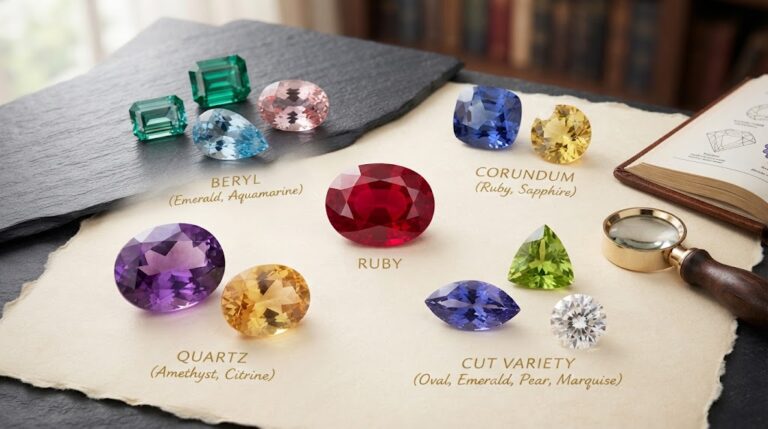 Gemstone Types, Colors, Shapes and Cuts ExplainedRound, oval, pear, faceted or smooth? This visual guide breaks down the most common gemstone cuts, shapes and colors, and…
 Rough Stones vs. Tumbled Stones vs. CabochonsThree finishes, three very different uses. Compare rough, tumbled and cabochon stones side by side to see how each is…